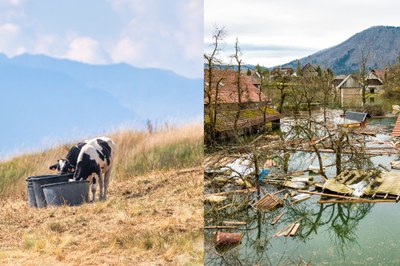
A heat record for June at 5,000 metres
For the first time ever, above-freezing temperatures in June were recorded at over 5,000 metres in the Alps – a new heat record with symbolic significance. At the same time, the new climate report for Austria confirms that the Alpine region is particularly affected by climate change.

Zero degrees at an altitude of 5,000 metres, and above-freezing temperatures at Switzerland's highest point: on 28 June 2025, temperatures climbed above zero even at the summit of the 4,634-metre Dufourspitze. This extreme value confirms a long-term trend: since 1961, the average altitude at which the air temperature is zero degrees Celsius has risen by 300 to 400 metres in the Alps. “The Alps are Europe's thermometer – and this thermometer is sounding the alarm. The latest extreme events show once again that we must not waste any more time: ambitious climate protection must now be a top priority”, warns Uwe Roth, President of CIPRA International.
Heat waves and mudslides
Current examples of the consequences of the climate crisis can also be found in all Alpine regions in 2025: At the end of May, a gigantic landslide almost completely buried the village of Blatten in Valais, Switzerland, under millions of tons of debris and ice. At the end of June, a heat wave was followed by heavy rain and flooding: mudslides devastated the Gschnitztal valley in Austria and, in France, a mudslide buried the tracks at Mondane station, interrupting rail traffic between Paris and Milan. In Bardonecchia, Italy, a man drowned in the floods of the Frejus River, which had burst its banks. Finally, a recent study conducted by the Universities of Lausanne (Switzerland) and Padua (Italy) found that a regional temperature increase of 2°C could double the frequency of heavy rainfall in summer.
Responses to the climate crisis
According to the latest Austrian climate report, the temperature has risen by around 3.1°C since 1900. The report documents an increase in hot days, heavy rainfall and dry periods. In addition to adapting to the rapidly changing climate, it also emphasises climate protection. Alpine communities should increasingly rely on local renewable energy sources such as photovoltaics, small hydropower and biomass. Tourism in the Alpine region should become more climate-friendly, through increased travel by train and bus, avoiding energy-intensive artificial snow in ski tourism, and year-round, nature-based offerings. Extensive grazing, the preservation of moors and wetlands, and climate-friendly forests should also be promoted.
Sources and further information:
www.srf.ch/meteo/meteo-stories/ausflug-auf-5000-meter-sogar-der-temperatur-ist-es-zu-heiss-nullgradgrenze-mit-rekord (de), www.uibk.ac.at/de/newsroom/2025/neuer-klimabericht-zeigt-klimawandel-trifft-osterreich-besonders (de), www.oeaw.ac.at/news/warum-oesterreich-vom-klimawandel-besonders-stark-betroffen-ist (de), https://aar2.ccca.ac.at (de, en) www.srf.ch/news/gletscherkollaps-im-oberwallis-blatten-nach-der-katastrophe-die-neuesten-bilder (de), https://en.wikipedia.org/wiki/2025_Blatten_glacier_collapse (de), https://tirol.orf.at/stories/3311719/ (de), www.suedtirolnews.it/italien/unwetter-in-norditalien-fordern-ein-menschenleben (de), www.ansa.it/piemonte/notizie/2025/07/05/alluvione-a-bardonecchia-piemonte-chiede-stato-di-emergenza_c88fcf9c-dbad-4d40-aeeb-9b4d9c4ba01c.html (it), www.lefigaro.fr/voyages/paris-milan-le-trafic-ferroviaire-coupe-pour-plusieurs-jours-apres-les-orages-20250701 (fr), www.unil.ch/news/en/1750322233506 (de,fr,it,en)
Further information
Alpine water: who gets the last drop?