
Search
153 items matching your search terms.
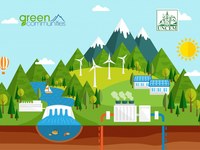
The “Green Communities” in the Italian Alps
Sustainable management of the built heritage, energy efficiency, environmentally friendly mobility: how can mountain areas be upgraded and the overuse of natural resources curbed? The first “Green Communities” in Italy want to show that this is also possible in a socially acceptable way.
News
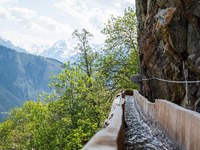
Waale, Suonen, Wasserleiten
Vital for the cultural landscape and biodiversity, and the epitome of community resource management: an application to UNESCO aims to turn traditional irrigation practices into an intangible cultural heritage asset.
News
Eco.mont special issue: Biosphere Reserves in Mountain Regions
On the occasion of 50 years Man and the Biosphere Programme the Austrian MAB National Committee has organized and financed a special issue on Biosphere Reserves in Mountain Regions in eco.mont. The special issue contains 16 articles from four out of five MAB regions.
Publication
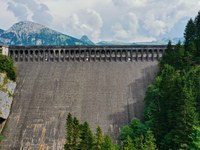
Hydropower in the Alps
How much hydropower use is environmentally compatible and ecologically sustainable? This question has been on the minds of people in the Alpine region for decades - all the more so against the backdrop of the urgent need to move away from fossil fuels. There are currently around 21,000 hydropower plants in operation in Europe, 300 under construction and over 8,500 in the planning stage. In many places, climate change with its imponderables such as extreme floods is being countered with more dams and walls, although river widening, for example, would make more ecological sense.
Position

For drinkable water
In a referendum held at the beginning of July, Slovenia’s citizens voted by a clear majority in favour of preserving the shore and coastal zones. In doing so, they overturned a new law that would also have affected Alpine waters.
News
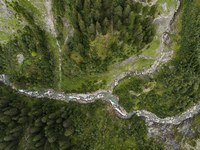
How much hydropower is ecologically sustainable ?
Renovate power plants instead of building new ones, preserve the last freshwater pearls, coordinate use and protection across countries: CIPRA has published a position paper with detailed technical demands on the use of hydropower in the Alps.
News

Point of view: Water will not tolerate resistance
Extreme weather conditions are also increasingly affecting the Alps. The climate crisis is driving this development. Can more and more dams, barriers or power stations solve the problem and at the same time satisfy the growing hunger for energy? We must work with the power of water rather than against it, says Kaspar Schuler, CIPRA’s Executive Director and co-author of CIPRA’s new position paper on hydropower.
News

Point of view: Water needs no borders – do we?
So far, sufficient water is available in the Alpine regions. If there is to be enough for everyone in the future, despite climate change, water must be treated as a common Alpine resource across national borders, says Marion Ebster, Project Manager at CIPRA International.
News
Re-Imagine Alps
[Project completed] Relations between humans, and between humans and nature, are the focus of the “Re-Imagine Alps” project. People take responsibility for their environment when they feel concerned and involved. Landscape here serves as a frame of reference and focal point for the perception and communication of sustainability issues: various relationships, memories and visions are illuminated in respect of, by, and for landscape in the overall Alpine context. Responsibilities and obligations grow out of ideas and relationships.
CIPRA Project
Nature providing services in the Alps
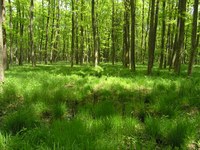
Whether mountain forests that protect us from avalanches and clean our air, or rivers and alpine pastures that provide us drinking water, energy or nourishment: in the AlpES Project ten partner organisations from six alpine countries have evaluated and documented ecosystem services for the past three years. They will present their results on 21st and 22nd November 2018 at a Final Event in Innsbruck/A. Press representatives are kindly invited to attend.
Press/Media release

Rivers connect people
The partners of the Spare Project are as diverse as they are at home in different Alpine countries, comprising as they do a university, two research agencies, two official bodies, a regional office, and two environmental organisations. Together they demonstrate how river management can be improved above and beyond administrative, cultural and technical boundaries.
News
The Alpine Rhine fête
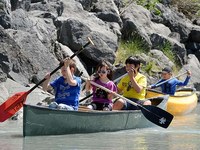
CIPRA Liechtenstein. Taming Europe’s biggest torrent began some two hundred years ago. Today, the Alpine Rhine is a canal, its course lined for the most part by intensively used farmland and residual pockets of wetland forest.
News
“A picture speaks a thousand words” - SPARE Project communicating through multimedia
With a brand new collection of infographics and photo books the SPARE Project partners aim at visually communicating the current river management processes in each of the project’s five Pilot Case Study sites.
News
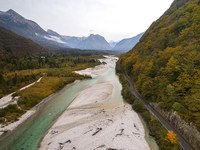
International Day of Action for Rivers
Fishing, farming, swimming, canoeing, hiking, drinking…. All in all, we are thousands of people benefiting from the resources provided by alpine rivers. However, only healthy rivers can provide these so-called ecosystem services. Alpine river ecosystems are vulnerable and often under pressure from various human activities. Can we do more to protect them? Yes!
News
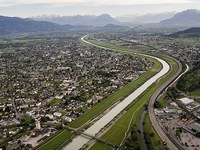
One river, numerous desires: disagreements about the Alpine Rhine
A current bone of contention between different interest groups is the priority to be given to the various uses made of the Alpine Rhine: as a farming area, as a habitat for the little ringed plover and the German tamarisk, or as a drinking water reservoir. SPARE, a new European Union project for the Alpine region, will offer assistance for the holistic management of watercourses.
News
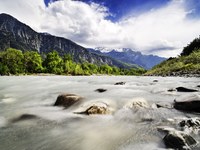
SPARE – Alpine rivers as society’s lifelines
What is the state of the Alpine rivers? How can we bring those responsible and other interested parties to committing themselves to holistic river management? The SPARE project strives to answer these and other questions. CIPRA and eight additional partners have launched the three-year project at a two-day meeting in Vienna in early February 2016.
News
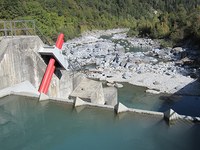
Better protection for Alpine rivers
A European legal ruling has strengthened the protection of Alpine rivers. Derogations for hydro plants or snow-making facilities are now more difficult to obtain. The politicians are up in arms.
News
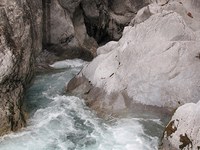
The real treasure of the Alps
A Swiss energy producer is to receive a prize for finding a successful compromise between the protection and use of water: while the head of the Upper Allgäu district authority has approved the building of a small power plant in a protected area over the head of his own officials. Two examples of the tension existing between conservation and the energy transition.
News
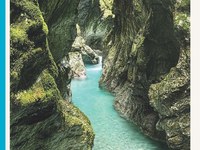
Save the alpine rivers!
WWF European Alpine Program, 2014
Publication
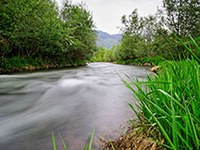
Alpine rivers are not renewable
Towards a fully sustainable energy strategy in the Alps
Position
Salmon coming to the Rhine
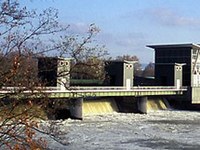
From the Atlantic to the Alps: by 2020 the Rhine will once again be a home to salmon. These migratory fish will then be able to swim unhindered all the way to Basel -short-term by unconventional means where necessary.
News

"Landscape is not renewable"
Must the Alps really be squeezed to the last drop so they can contribute yet more to the energy transition? The CIPRA annual conference on "The Alps as a Water Trough" saw more passionate debate on this topic than any other.
News
National parks remove exotic fish species
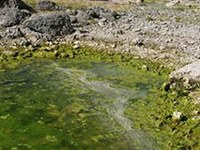
Collecting what was released into the wild fifty years ago is the order of the day in the Gran Paradiso and Triglav National Parks, where the fish species introduced have had serious effects on the natural environment.
News
CIPRA's Annual Conference: "The Alps as a Water Trough"
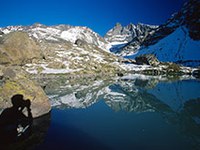
The "blue gold" of the Alps is limited in quantity and thus in high demand for use as drinking water, snow or electricity. At its Annual Conference in Bozen/Bolzano in October 2013, CIPRA will be asking who has the right to this elixir of life and who has responsibility for it.
News
Alpine water resources in private hands?
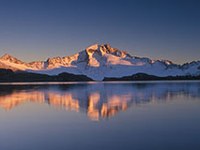
The proposal from Brussels on the privatisation of water supplies is making waves on account of the content of the regulation and also the successful citizens' initiative that aims to stop it. Finally, this article explains why a joint strategy is needed, both for the Alpine space and for Europe.
News

Improvements in efficiency instead of damage to the environment! cc.alps: CIPRA's demands on the subject of water
The rivers of the Alps provide 170 million people with water. Climate change will greatly reduce the availability of water in the Alps and beyond, with less rain, longer dry periods in summer and greatly reduced snowfalls in winter among the predicted consequences. The demands made of this natural resource will increase accordingly, as will competition between the various user groups. Today only about 10% of the rivers and streams of the Alps can be considered ecologically intact, i.e. they are neither polluted nor over-engineered nor compromised in terms of their flow regimes. The ecological quality of waterways and related habitats therefore calls for improvement, not further impairment. We cannot permit the last rivers to become engineered structures or depleted by the excessive abstraction of water.
Position
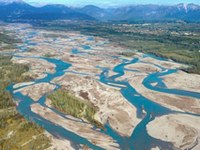
Respite for the "king of the Alpine rivers"
It looks like no gravel is to be extracted from the Tagliamento for the time being. The company that was planning to extract more than a million cubic metres of ballast between Cimano/I and the Arzino tributary has withdrawn its project.
News
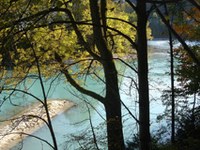
Power plant expansion on the Lech at the expense of nature conservation?
The Lech river in Bavaria/D is already being used on a massive scale for electricity generation, and only the stretch at Augsburg/D remains undeveloped. But even this section of the river could very soon become the site of a hydroelectric power plant. The expansion plans are not an isolated case; rather, they reflect a trend throughout the Alps, and one that is gathering momentum.
News
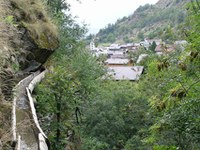
Swiss research into sustainable water use
Melting glaciers create new lakes in the Alps. This creates new tourism potential and new risks, such as floods and landslides, for the inhabitants of the valleys. Where and when are such lakes created? Who owns them and who is responsible for them?
News
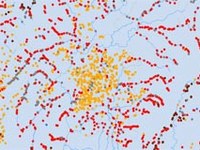
Obstacles and facilitations for the movement of fishes
An inventory of all the artificial barriers that impede the flow of rivers has found out that French rivers are interrupted by 60,000 dams, weirs, locks, mills etc. The inventory has been recently published as a online map where the works are shown divided by department, municipality or watercourse. All these works obstruct the movement of migratory aquatic organisms and the transport of sediments, thereby affecting ecosystems.