MultiBios

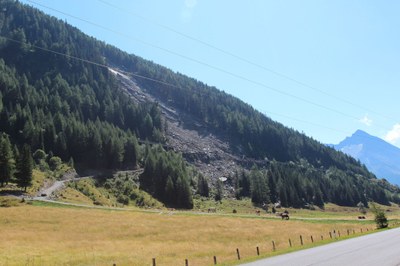
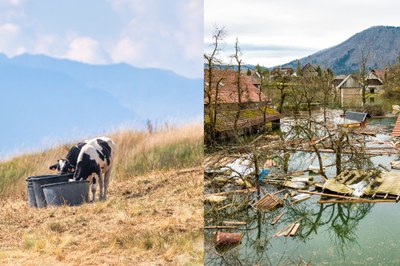
Droughts, floods, and other natural hazards are becoming more frequent due to climate change—sometimes even occurring simultaneously. How can we as a society learn to deal with this and become more resilient? What role can biosphere parks in the Alpine region and beyond play in this?
A new research project involving CIPRA is addressing these questions. The project "MultiBios" focuses on the overlapping of climate risks such as heat, drought, and flooding. As Wolfgang Pfefferkorn, project manager at CIPRA International, explains: “In the project, we are investigating the role of biosphere parks in dealing with multiple climate risks and how they can be strengthened in this regard.” Other partners include the Institute for Social Ecology at the University of Natural Resources and Life Sciences (BOKU) in Vienna and the International Institute for Applied Systems Analysis (IIASA) in Laxenburg, Austria, which coordinates the project.
Full Project Title
MultiBios (Multiple Risks in Biosphere Parks – Managing Multiple Hydroclimatic Risks to Improve Socio-Ecological Resilience)
Project Goals
- Investigate and strengthen the role of biosphere parks in natural hazard management
- Improve collaboration between scientists and local stakeholders to enhance the climate resilience of regions
Activities
- Establish a transdisciplinary group to accompany the project from start to finish
- Analyze the political and institutional frameworks for dealing with droughts and floods
- Conduct interviews with regional stakeholders in biosphere parks: mayors, administrators, landowners, businesses, and civil society
- Facilitate knowledge exchange and transfer of insights between the Wienerwald Biosphere Park (Austria) and six other biosphere parks in Austria, Germany, and Switzerland
- Host three transnational workshops, the first of which will take place in spring 2024 in the Wienerwald Biosphere Park
- Publish and disseminate the results in both scientific and broader contexts
Project Duration
May 2023 – April 2025
Project Partners
- CIPRA International
- University of Natural Resources and Life Sciences, Vienna (Institute for Social Ecology)
- International Institute for Applied Systems Analysis (IIASA)
Participating UNESCO Biosphere Reserves
- Wienerwald Biosphere Park (Austria)
- Salzburger Lungau & Kärntner Nockberge Biosphere Park (Austria)
- Murtal (Austria)
- Großes Walsertal Biosphere Park (Austria)
- UNESCO Biosfera Engiadina Val Müstair (Switzerland)
- Black Forest Biosphere Reserve (Germany)
Project Languages
German, English
Contact
Wolfgang Pfefferkorn
wolfgang.pfefferkorn@cipra.org
Funding
The two-year research project is funded by the Austrian Academy of Sciences with nearly €170,000 as part of the UNESCO "Man and Biosphere" (MAB) programme. Additionally, the project receives financial support from SCNAT in Switzerland (CHF 10,000) and the German MAB National Committee (€10,000).
Final report MultiBios
Further information
Climate risks: better to prepare than to wait
After the flood
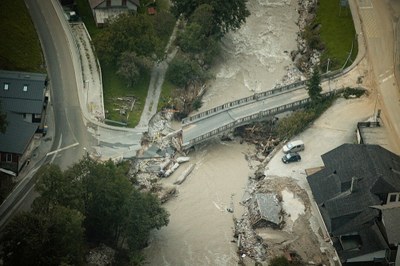
Flooded mountains