
News
First carbon-footprint calculation for a ski school
The carbon footprint of a ski school in France has been measured for the first time.
Energy-efficient buildings under discussion
The Director of the Passive House Institute in Darmstadt/Germany, Wolfgang Feist, and the Director of the ClimateHouse Agency in Bolzano/I, Norbert Lantschner, have responded to questions about energy-efficient construction in interviews.
A European League for renewable energies
The RES Champions League is a network of national renewable energy leagues and also a competition for renewable energies between European cities, towns and villages, which was launched on 23 April 2009 at the annual meeting of Énergie-Cités and the Climate Alliance.
Manifesto for sustainable building
The KlimaHaus Agentur in Bolzano/I is calling for the signing of the "Manifesto for Sustainable Building".
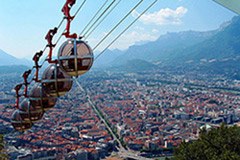
400 European municipalities committed to climate change issues
400 European towns, cities and municipalities have signed the Covenant of Mayors.
Climate Star 2009
To the motto of a "Short Track to Climate Protection", the Climate Alliance is inviting all European towns, cities and municipalities, for the fourth time, to apply for a Climate Star with an exemplary climate protection project of their own.
Climate Action: Energy for a Changing World
In December 2008 the European Commission adopted an integrated energy and climate change policy and defined specific targets for 2020.
Solar thermal power plant in the French Hautes-Alpes
The energy companies Dalkia and Solar Euromed have joined forces and plan to build the first solar thermal power plant in France. The plant is to be built in Chevalet d'Aspres sur Buech and will generate some 60,000 megawatt-hours of electricity.
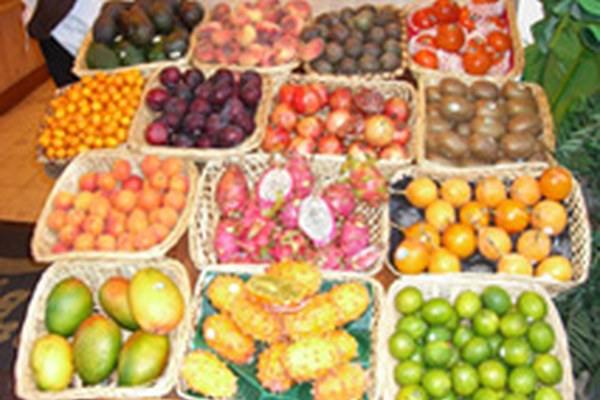
Rail tunnel ground water to heat a tropical greenhouse
In the future, the ground water that drains from the Lötschberg Base Tunnel at a temperature of 20°C will be piped into a tropical greenhouse which is to be built at the northern portal in Frutigen/CH to produce fish and tropical fruit, and also to heat the administration building.
Energy supplies at risk from shrinking glaciers
The shrinkage of the Mer de Glace in the French Alps is having a tangible impact on the use of hydropower.
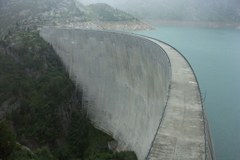
New publication on mountain dams
The new March issue of the bilingual magazine La revue de géographie alpine / Journal of Alpine Research looks at impoundment dams and new challenges in mountain areas.
EU funds for fifty harmful projects
At the end of February Friends of the Earth Europe and CEE Bankwatch published a list of 50 environmentally damaging and economically dubious infrastructure projects in Central and Eastern Europe, which are either financed or planned to be financed by the European Investment Bank (EIB) and EU regional development funds.
Will Europe's largest photovoltaic installation soon be in the Alps?
Europe's largest photovoltaic installation is set to be built in the French département of Alpes-de-Haute-Provence. Negotiations have already taken place for the lease of the plot of land on which the installation is to be built, at an altitude of 1,000 m above sea level.
Werfenweg has Austria's longest solar-powered street
The Municipality of Werfenweng in Salzburg is saving €38,000 by using solar lighting. 17 recently installed solar streetlights have proved to be the cheapest way of lighting a path some 700 m long on the town's outskirts. This makes it currently Austria's longest solar-powered street.
Negative CO2 balance in the Alpine region
The Alps have the potential to become a model region for climate protection. And yet today, on a global comparison, every inhabitant of the Alps is contributing disproportionately to the greenhouse gas emissions affecting the climate.
International Conference: The Alps beyond Kyoto
CIPRA, the International Commission for the Protection of the Alps, is organising an international conference on energy efficiency and renewable energies in the Alpine region from 20 to 22 September.
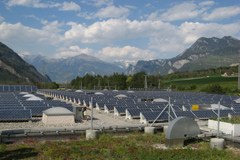
The Alps ideal for generating solar power
According to a study by the EU research laboratory for the environment in Ispra/I the profitability ratings for solar power installations in Alpine regions are similar to those of solar installations in southernmost Spain. Solar irradiance in the hills and mountains of Austria for example reaches an intensity of up to 2,000 kilowatt-hours per square metre.
International trade fair and conference on renewable energies in Aosta
The trade fair and conference entitled "Rigenergia: Renewable energies and energy-saving in architecture and construction in the mountains" is being held in Aosta from 7 to 9 June.
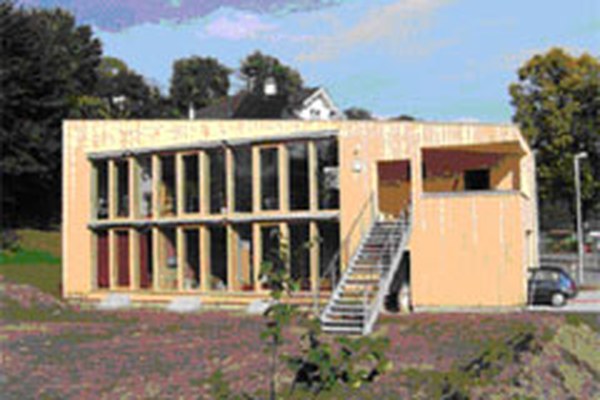
Davos on the road to Kyoto
Davos, Switzerland's highest town, is working towards a more climate-friendly local policy.
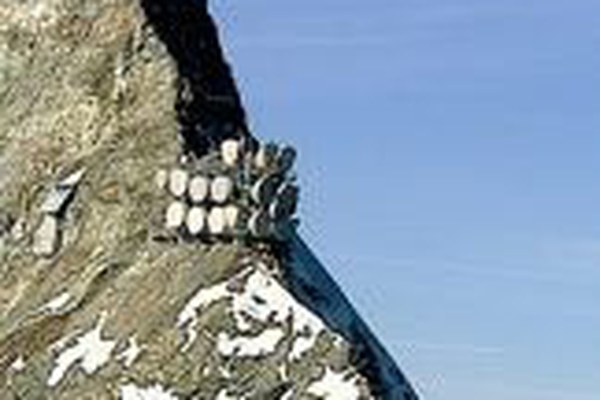
Tests underway on the world's highest solar power station
The Swiss utility BKW FMB Energie AG is currently conducting trials scheduled to last until this summer on a high-alpine solar power station.
Decrease in water runoff from the Swiss Alps
A new study analyses the impact of a potential climate change on hydrological discharge regimes from the Swiss Alpine region for the period between 2020 and 2050. Eleven catchment areas with different glaciation rates and altitude ranges were examined.
2005 European Solar Prize announced
Eurosolar is again awarding the German and European Solar Prizes in 2005, with 31 August as the deadline for submissions.
NEGST- New Generation of Solar Thermal Systems
The overall objective of this project is to introduce more cost-effective solar thermal systems, particularly for domestic hot water preparation and / or space heating, to the market in order to contribute to the European Union's Action Plans with regard to the reduction of CO2 – Emissions and the cost effective supply of renewable energies.
Green energy in Austria
Things are looking good for green energy in Austria. In the region of Lower Austria, for example, 2004 saw the construction of more biomass heating plants, biogas digesters and wind power plants than ever before. Today about seven percent of the electricity generated in Lower Austria is a product of wind, biomass or biogas.
South Tyrol: energy-efficient house construction now mandatory
On 12 January a new regulation on climate-friendly house construction took effect in South Tyrol. According to the provisions of this Climate House Ordinance, the Provincial Office for Air and Noise must issue a climate pass for all new housing in South Tyrol showing the buildings' energy classification and thermal heat requirements.
Artificial high water affects ecology of running water
A new WWF study shows that the artificial high-water (surges) and low-water (sinks) caused daily by hydraulic power plants are having disastrous repercussions on the ecosystem of running water.
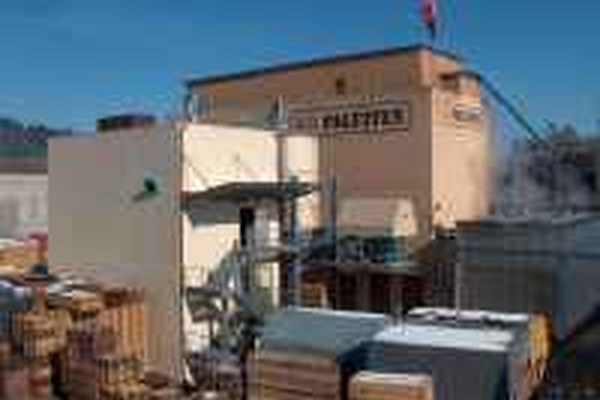
The Emmen valley - The vision of a valley heated without oil
Timber and solar energy rather than oil, gas and electricity are to be the heating resources of the future in Switzer-land's Emmen valley. Although the Emmen valley region is densely forested, each year it still buys in some CHF 30 m's worth of oil, gas and electricity - while more than half the wood accruing each year simply rots away in the region's forests. It's a situation the "Oil of Emmental" project hopes to remedy.
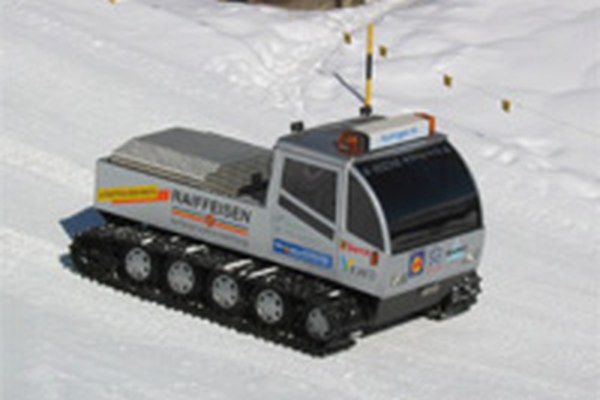
Hydrogen-powered piste vehicles in the Alps
The Swiss association Swiss Alps 3000 has launched a new campaign aimed at zero-emissions mobility in the Alps. As part of the campaign it presented the prototype of a hydrogen-powered piste vehicle. The first vehicle of this type was tested during winter 2003/2004.
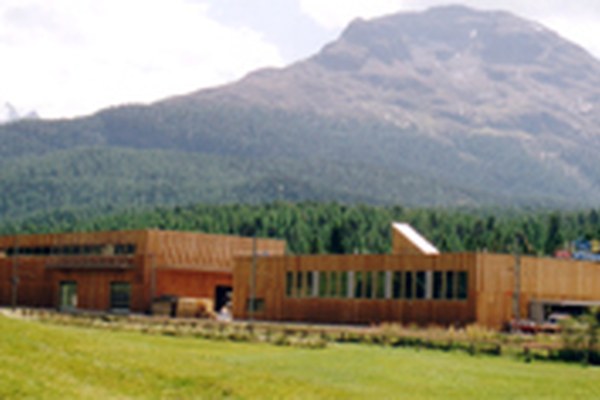
Ultra-low energy building gains altitude
The highest ultra-low energy business premises of the Alps were officially opened in Punt Muragl (En-gadine/Switzerland) at the end of August. Gasser Building Materials' 23,000 m3 warehouse with integrated DIY store is situated at an altitude of 1,728 m above sea level and is heated almost exclusively by solar energy.
Electricity and heat essentially from renewable energies
By 2050 65% of electricity consumption and 50% of heating requirements in Germany could be provided by renewable energy sources.