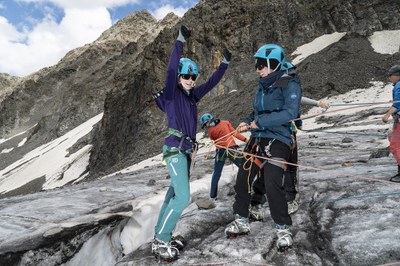
“Young Glacier Voices” presented at the Forum Alpinum
Félicie Weiss, part of the project Young Glacier Voices as representant from the partner organisation Girls* on Ice Austria, participated to the Forum Alpinum 2026. We asked her a few questions about her experience.
 Pitching the project Young Glacier Voices during the poster sessions. (c) Felicie Weiss
 Checking in – what a great opportunity to be there! (c) Felicie Weiss
 Interesting panel discussions involving various stakeholder (c) Felicie Weiss
 Walking in the beautiful surroundings of Aosta before the first session in the morning. (c) Felicie Weiss
 Visiting the Testa Grigia Observatory explained by the impressive Dr. Gilardoni Stefania. (c) Felicie Weiss
 Floating above an arty patchwork of rocks, snow, water and grass. (c) Felicie Weiss
Félicie, why did you take part in the Forum Alpinum 2026?
This year’s theme was ‘Alpine communities and regions in times of glacier retreat and climate change’, which fits perfectly with the scope of our ‘Young Glacier Voices’ project, as both focus on environmental challenges, socio-economic impacts, changes and adaptation strategies relating to the consequences of glacier melt in the Alpine regions (and beyond). My role at the Forum Alpinum was to present the “Young Glacier Voices” project during a poster session. I also wanted to learn more about the activities of various stakeholders in the Alps and the scope of the Alpine Convention’s work. Furthermore, I was looking forward to making new contacts. I was also hoping for new ideas to bring in activism for glacier protection.
How did you feel in this setting? Were your expectations met?
It was a great honour and very inspiring to see internationally renowned researchers, early-career academics, policy-makers and committed citizens coming together to share their perspectives and listen to one another as part of an enriching programme of lectures, panel discussions, workshops, films and excursions. I am not a scientist and sometimes felt a little out of my depth, but at the same time I was able to ask very practical questions relating to our social work-field. The forum enabled me to link the scientific and social aspects of our project more closely together in order to enhance its impact. I was also delighted to meet (or see again) some very friendly and talented colleagues from various Alpine regions.
Have you reached your goal of spreading the word about the project?
Of course, the poster session, during which I presented our project over the microphone to an impressive audience, was definitely the best way to draw attention to us! But so too were the ‘hidden’ moments during the breaks and walks, when formal barriers came down as we chatted on equal terms, and people (regardless of their position) began to engage with their own emotions and thoughts, rather than just those brought about by their work. They then showed great interest in civic engagement and the educational impact of the ‘Young Glacier Voices’ project.
What topics will you bring back from the conference to integrate in the Young Glacier Voices project?
It was inspiring to discuss the various perspectives that go beyond the current situation regarding glacier melt. The discussion not only addressed the increasing negative consequences of climate change in the Alps and the protection of the remaining ecosystems through climate protection measures, but also highlighted adaptation strategies and best practices. Various approaches, analytical methods, communication channels and reflective strategies were highlighted – covering physical environmental aspects (water management, risk management, changes in biodiversity) as well as social (migration, mourning the loss of glaciers), political (governance of climate action and adaptation), cultural (food, rituals and the commons) and economic (sustainable tourism, energy cooperatives) aspects. This has broadened the range of topics we can convey to youth communities across the Alps as part of our project.
What was your highlight?
My highlight was the trip to the Plateau Rosà. We had a fantastic view of the landscape (an unusual sight in the off-season) and an impressive visit to the Testa Grigia Observatory, led by the remarkable Dr Stefania Gilardoni (Italian National Research Council, Department of Earth System Sciences and Environmental Technologies). She told us about the history and remit of the centre and explained how high-tech measuring instruments (e.g. ICOS) work. But she also took the time to answer all our questions and spoke very openly about her personal experiences as a woman in STEM, as well as her commitment to promoting education in the field of climate protection – topics with which I could very much identify through my work with “Girls* on Ice Austria” and as part of the “Young Glacier Voices” project.
About the The Forum Alpinum
The Forum Alpinum 2026 took place in Aosta/I from 28 to 30 May 2026. Every year, ISCAR (International Scientific Committee on Research in the Alps), in collaboration with partners from across the European Alps, organises an international conference at which researchers, policy-makers and practitioners discuss the sustainable future of the Alpine region in accordance with the principles of the Alpine Convention. Designed as an interface between science and politics, the Forum Alpinum provided opportunities for scientific and political dialogue, with a particular focus on the younger generations. https://forumalpinum.org/ (en)
The Erasmus+ project "Young Glacier Voices" is co-funded by the European Union.

Further information