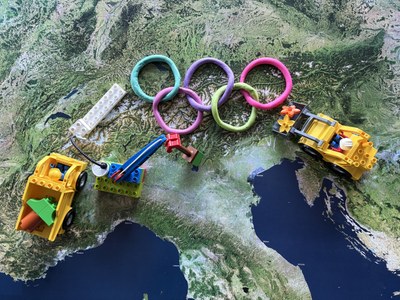
Winter Olympics on shaky ground
Use as much concrete and steel as possible: that seems to be the sustainability strategy for the Winter Olympics in the Italian Alps. Mountain communities are particularly affected. The icing on the cake is the construction of a new cable car on a slippery slope in Cortina.
 One of the most controversial Olympic construction sites: the Apollonia-Socrepes gondola lift in Cortina. (c) Fabio Tullio
 One of the most controversial Olympic construction sites: the Apollonia-Socrepes gondola lift in Cortina. (c) Fabio Tullio
 The Olympic Village in Cortina will be dismantled after the Games. (c) Fabio Tullio
 €118 million for the construction of a new bobsleigh track in Cortina — despite IOC recommendations to use existing venues. © Fabio Tullio
Despite geological concerns, public opposition and a negative environmental assessment, a new gondola lift is being built in Cortina on a slope prone to landslides. Renowned cable car companies did not even bid for the problematic construction project – and for good reason: just last summer, a 40-metre-long crack opened up across the slope. Until recently, it remained unclear whether the cable car would even be ready in time for the Winter Olympics.
Compulsory administration instead of environmental compatibility
Initially, the Milan-Cortina 2026 Foundation invited environmental organisations to discuss the environmental impact of all construction projects. However, this led to a breakdown in relations, with the foundation placing the construction sites under compulsory administration. As a result, more than half of all construction projects were exempted from environmental impact assessments. In response to this lack of transparency, a citizens’ network, “Open Olympics 2026”, was formed with twenty partner NGOs, including CIPRA Italy. According to the network, more than half of all 98 planned construction projects will not be completed until after the Winter Games, and they fall into the “legacy” category for the Games’ operating company. Most of these are road construction projects. A total of 3.5 billion euros is being invested: three quarters of all construction work will not be completed on schedule, some with delays of up to three years. The last construction site is scheduled for completion in 2033. In contrast, the controversial €118 million bobsleigh track in Cortina was built in record time. In Antholz, South Tyrol’s biathlon and cross-country skiing mecca, 2.5 hectares of forest in a local recreation area were cleared to build a new reservoir for snowmaking on the cross-country trails, despite resistance from the local population. In its new position paper, CIPRA calls for comprehensive reforms by the International Olympic Committee (IOC) and the host countries.
Comments on Milan-Cortina 2026
“Milan-Cortina 2026 highlights the huge gap between aspiration and reality at the Winter Olympics. Instead of sustainable development, only the construction industry benefits, at the expense of the local people, environment and nature. After all, the Alps are a sensitive habitat, not a playground for short-term interests.”
Jakob Dietachmair, Managing Director of CIPRA International
“Behind the glamour of the Olympic celebrations, the Alps are in danger of being suffocated by endless construction sites. Between medals and concrete mixers, Milan-Cortina 2026 tells the story of the paradox of a winter sports festival that has to produce its own artificial snow, then calls this progress.”
Vanda Bonardo, President of CIPRA Italy
“Despite promises of reform and the IOC’s sustainability strategy, the preparations for Milan-Cortina 2026 show once again that the current Olympic model is anything but sustainable.”
Uwe Roth, President of CIPRA International
“Once again, it is the mountain regions that bear the greatest pressure, the greatest burden on the population and the greatest environmental destruction. But without them, the Games could not take place: after all, you can’t ski in Milan!”
Francesco Pastorelli, Managing Director of CIPRA Italy
“All venues must be supplied with 100 per cent artificial snow, as there is no natural snow. Now there is a shortage of water for snowmaking. However, the organisers are simply ignoring this. They treat water as if it were their property and not a common good.”
Hanspeter Staffler, Managing Director of CIPRA Südtirol
“The Winter Olympics should adapt to their host regions, not the other way around. Milan-Cortina 2026 shows how ignoring local needs can result in infrastructure with no real future. Winter sports need healthy mountains, and the Olympic legacy should contribute to protecting these mountains.”
Agnese Moroni, President of Protect Our Winters Italy
“The 2026 Winter Olympic Games are not sustainable. The Strategic Environmental Assessment (SEA) of all planned projects was avoided – an essential tool for measuring sustainability and for considering the zero option as well. Local communities and associations were not involved in the planning of the 98 projects included in the Olympic programme. These Olympic Games represent the failure of the IOC’s Olympic Agenda 2020 + 5.”
Luigi Casanova, President of Mountain Wilderness Italy
“As one of the largest and most beautiful sporting events in the world, the Olympic Games – whether summer or winter – should also serve as a beacon for nature and the environment and make do with as few new, purpose-built facilities as possible. These Winter Games prove once again that this is not the case, as new sports venues are being built at great expense without taking into account that alternatives already exist nearby.”
Georg Simeoni, President of AVS (South Tyrol Alpine Club)
“Major sporting events such as the Olympic Games must be completely rethought in order to minimise their impact on nature and the landscape. Regulations for the sustainable and transparent organisation of such major events must be further developed and then complied with by the organisers.”
Barbara Ernst, President of Club Arc Alpin
Press photos of the Olympic construction sites:
https://public.3.basecamp.com/p/ftzTUympndSB4WbNsUMLywek/vault
Further information:
Jakob Dietachmair, CIPRA International (Executive Director), jakob.dietachmair@cipra.org
Michael Gams, CIPRA International (Communications), michael.gams@cipra.org
Further information
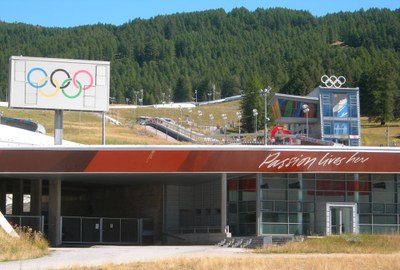
The next unused bobsleigh run