Boundaries between nature, community and lived utopias
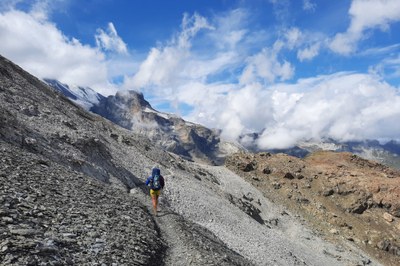
 Eleven young adults hiked in the South Tyrolean Alps as part of the Via Alpina Youth project. (c) CIPRA South Tyrol
 Initiator Sigrid Regensberger gave the group an insight into the social enterprise Vergissmeinnicht. (c) CIPRA South Tyrol
 Experiencing nature during a hike can strengthen the community. (c) CIPRA South Tyrol
 Challenges are easier to master as a team. (c) CIPRA South Tyrol
The excursion focused on the question: “What does inclusion mean, and how can it be achieved in our society?” Its aim was to explore the concept of “cross-border wanderers” on personal, social, and geographical levels.
The journey began with a visit to Vergissmeinnicht in Bruneck. Founder Sigrid Regensberger showed the group how people with difficulties are actively integrated into the activities of this social enterprise. Participants gained insights into the shop, the tailoring workshop, and the planning spaces, experiencing firsthand how inclusion, sustainability, and social responsibility can be meaningfully connected in everyday life.
While hiking along the Via Alpina from Antholz-Mittertal to the Ochsenfelderalm, the group learned how shared experiences in nature can strengthen community and foster awareness of cohesion and mutual support. During survival exercises led by Philipp Schraut, collaboration remained key: building shelters, lighting fires, and exploring nature together—facing challenges that could only be mastered as a team.
To conclude the project, participants met online to exchange their experiences and deepen their understanding of inclusion in a discussion with the director of the Art Workshop & Gallery Akzent in Bruneck, who presented a project run by Lebenshilfe. This combination of practical experience, reflection, and social participation made the essence of inclusion vividly tangible.
The success story of the Vergissmeinnicht social cooperative and the Art Workshop & Gallery Akzent
Both projects have many years of experience and a proven track record of success. Vergissmeinnicht, founded in 2015, celebrates its tenth anniversary in 2025 – a milestone that highlights the economic sustainability and viability of its retail concept in Bruneck. Likewise, the Art Workshop & Gallery Akzent, established in 2011, demonstrates through more than a decade of successful activity the relevance and meaningfulness of its cultural and artistic approach.
Sigrid Regensberger founded Vergissmeinnicht to create a perspective for her daughter, who can be described as a “border crosser.” Because of her difficulties, she cannot be integrated into a regular workplace—the demands are simply too high—while at the same time, she would not feel at home in a sheltered workshop for people with disabilities. In South Tyrol, the school system places strong emphasis on inclusion for people with disabilities, but after secondary school many find themselves without suitable professional opportunities. Vergissmeinnicht was established to close this gap and to create long-term opportunities for participation in working life, particularly for Regensberger’s daughter.
The Art Workshop & Gallery Akzent in Bruneck was founded about twenty years ago as a private parents’ initiative. Its aim was to provide artists with disabilities a protected space in which they could express their creativity and engage in artistic work. The workshop promotes inclusion through artistic activity and encourages exchange with other cultural practitioners. Organized under the umbrella of Lebenshilfe Südtirol, its success is the result of close cooperation between support staff, artists with disabilities, and accompanying mentors.
How could these two projects be transferred?
The two projects differ significantly in their target groups, structures, and funding models, yet both demonstrate that their approaches can be transferred—albeit under different conditions.
Vergissmeinnicht is a privately run tailoring and clothing business. Its financing comes primarily from product sales, with only a small share provided through provincial funding for the inclusion of people with disabilities. The enterprise stands on solid economic ground, has built a loyal customer base, and has become a recognized brand beyond the borders of the province. Several requests for support in establishing similar initiatives elsewhere highlight its potential for expansion. Ms. Regensberger considers the transfer of this model both feasible and meaningful, but emphasizes that building a financially viable business requires a great deal of commitment and time.
The Art Workshop & Gallery Akzent caters to people with more severe disabilities, who would not be able to manage in an environment dependent solely on self-generated income. Accordingly, the workshop is primarily financed through provincial funding. By fostering exchange with other artists and being recognized within the South Tyrolean Artists’ Association, the workshop practices inclusion to the extent that it is meaningful for those involved. Participants experiment with new techniques and collaborate on exhibitions.
This model, too, is in principle transferable, as comparable institutions show: since 1985, the Community of Sant’Egidio has operated art workshops in several locations (e.g. Würzburg, Rome) as spaces for encounter and creative expression for people with and without disabilities. The Art Center “Besondere Menschen” in Ingolstadt enables inclusive projects for people with physical and intellectual disabilities, and the Art Workshop Lienz of Lebenshilfe Tirol follows a similar structure to that of the workshop in Bruneck.
Sources and links: https://vergissmeinnicht.bz.it/en/ (de, it, en), https://www.lebenshilfe.it/kunstwerkstatt-galerie-akzent-bruneck (de, it)
What: Working Inclusively in the Alps
Who: Sigrid Regensberger (founder from Vergissmeinnicht) and
Sarah Zingerle (director of of the Art Workshop & Gallery Akzent in Bruneck)
Where: Bruneck, South Tyrol
When: September 2025
How: Vergissmeinnicht was created to give people with disabilities a perspective and integrate them into working life. The Art Workshop & Gallery Akzent in Bruneck was founded by a private parents' initiative to provide a protected space for artists with disabilities.
Transferability: Ms Regensberger considers the transfer of the Vergissmeinnicht model to be fundamentally possible and meaningful, but points out that establishing an economically viable business requires a great deal of commitment and time. The model of the Art Workshop & Gallery Akzent is also fundamentally transferable, as demonstrated by comparable institutions in Würzburg, Rome, Ingolstadt and Lienz.
Further information